Have you ever assumed that „using a privacy wallet“ automatically means your on-chain activity, IP address and identity are protected? That assumption is the single biggest operational blind spot for privacy-conscious users. Wallet software can add strong layers — but each layer has a mechanism, an attacker model, and trade-offs. This article walks through how modern multi-currency privacy wallets (using Cake Wallet as a focal example) combine protocol-level privacy, device security, and in-wallet exchange, and where those controls succeed or break down for Americans managing LTC, XMR, BTC and other assets.
We open with mechanisms: what privacy primitives are actually doing under the hood, why they matter for Litecoin (MWEB), Monero (ring signatures and subaddresses), and Bitcoin (coin control, PayJoin), and how on-device features, network routing, and built-in swaps change the privacy calculus.
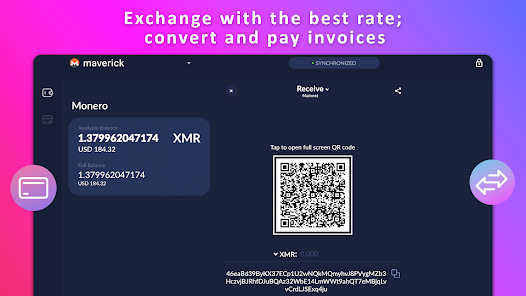
How the key privacy mechanisms work (and why the sequence matters)
Think in layers. At the protocol layer, Litecoin’s MWEB (MimbleWimble Extension Blocks) offers confidential transactions: amounts are hidden and transaction graphs are condensed, reducing linkability compared to legacy LTC outputs. Monero’s privacy is built into the protocol: ring signatures, stealth addresses, and one-time keys make it purposefully hard to link sender, receiver and amount. Bitcoin, by contrast, is inherently transparent; wallets improve privacy by using techniques such as PayJoin (which mixes inputs between participants), Silent Payments (address derivation that avoids reuse), and explicit UTXO coin control to avoid accidental linking.
At the network layer, privacy depends on hiding metadata. A wallet that can force Tor-only connections or support I2P and custom node endpoints prevents your IP from being trivially associated with transactions. Crucially, a wallet that lets you choose a node — or run your own — reduces the need to trust third parties for broadcasting. And at the device layer, hardware-backed encryption (Secure Enclave, TPM) and short PIN/biometric gating protect keys if the device is seized or stolen.
Trade-offs: built-in exchange, NEAR Intents, and the privacy surface
Built-in exchange is convenient — it keeps custody local and avoids sending coins to centralized services. Cake Wallet offers what many privacy users want: instant swaps among dozens of assets inside the wallet, and cross-chain routing through a system called NEAR Intents that automates decentralized routing to find competitive rates among multiple market makers. Mechanistically, NEAR Intents reduces reliance on a single intermediary by matching offers across participants, which can be better for UX and decentralization.
But convenience has privacy costs and limits. Any in-wallet swap involves additional counterparty interactions. Even if swaps are decentralized, routing and liquidity providers may learn trade metadata, timing, and amounts, which can be correlated with your on-chain activity by an observer with access to those endpoints. A core misconception is to treat on-device custody as complete privacy; it isn’t. Each external connection — node, swap provider, market maker — is an extra surface where correlation attacks can occur. The wallet’s zero data collection policy and open-source, non-custodial architecture materially reduce centralized telemetry risk, but they cannot erase the metadata footprint created by routing swaps across liquidity networks.
Specific coin considerations: LTC (MWEB), XMR and BTC
Litecoin MWEB: activating MWEB is optional. When used, it hides amounts and aggregates UTXOs, increasing fungibility. The catch: MWEB adoption and interoperability matter. If only a fraction of counterparties use MWEB, you can still leak history—receiving coins from a transparent pool or interacting with services that don’t support MWEB can reintroduce linkability. Operationally, users should understand when to enter and exit MWEB and accept that mixing between MWEB and legacy chains has different privacy properties.
Monero: Cake Wallet’s Monero features—background synchronization, subaddresses, and local-only private view keys—are textbook-good practice. The private view key never leaving the device reduces server-side leakage. Still, Monero privacy degrades if you reuse subaddresses, broadcast raw transactions without Tor/I2P, or pair addresses with public identities off-chain. Keep in mind that strong protocol privacy does not immunize you against operational mistakes.
Bitcoin: the wallet’s support for Silent Payments, PayJoin v2, UTXO coin control and batching gives sophisticated users the tools to reduce traceability. But privacy gains depend on counterparty adoption. PayJoin requires a cooperative counterparty; Silent Payments reduce address reuse only if the sender and receiver both use compatible schemes. For high-assurance privacy on BTC, combine these tools with Tor, custom nodes, and disciplined coin management.
Hardware integration and device security: the Cupcake model
Non-custodial wallets are only as safe as private key custody. Integrating hardware wallets (Ledger support and Cake’s air-gapped „Cupcake“) reduces the risk of keys being exfiltrated by malware. The device-level encryption using Secure Enclave or TPM, plus PIN/biometric gating, defends against physical compromise. Yet hardware security is not invincible: supply-chain attacks, compromised firmwares, or poor seed management remain plausible attack vectors. Always verify hardware provenance, update firmware from official sources, and treat seed phrases as high-value secrets.
Operational framework: a reusable decision heuristic
Here is a pragmatic heuristic to choose configurations depending on goals:
– Privacy-first, small regular spending: Use Monero for sensitive transfers, run the wallet in Tor-only mode, avoid in-wallet swaps unless they are fully off-chain or routed through trusted, privacy-preserving mechanisms. Use subaddresses and keep the private view key local.
– Mixed custody with liquidity needs: If you need to swap between BTC/LTC/ETH often, prefer NEAR Intents-style decentralized routing to single central exchanges, but add an intermediate privacy step (e.g., move coins into an MWEB pool or shielded ZEC) before swapping to maximize unlinkability.
– High-value, long-term storage: Use an air-gapped hardware wallet (Cupcake or Ledger), keep coins cold, and avoid frequent in-wallet swaps. If you do swap, broadcast via a separate networked device using Tor or a trusted relay.
Where wallets still fail privacy: limits and unresolved challenges
No wallet can fully defend against all real-world linkage risks. Key limitations to keep in mind: first, correlation attacks across exchanges, market makers and node operators remain an active threat; NEAR Intents reduces centralization but does not eliminate the ability of well-resourced observers to correlate timing and amounts. Second, cross-chain bridges and legacy-compatibility problems (for example with Zcash migration differences) introduce traps where seed incompatibilities or change-address behavior can leak metadata or force manual transfers. Third, legal and regulatory pressures in the US can compel service providers to log or disclose metadata—wallets that advertise „no telemetry“ still rely on external networks that may be compelled to cooperate with authorities.
Experts broadly agree that a layered approach (protocol privacy + network privacy + device security + disciplined operations) is necessary. They debate which layer should carry the heaviest weight: some favor maximizing protocol-level anonymity (Monero, shielded ZEC), others prefer systemic solutions such as privacy-preserving swap networks and better default UX for BTC privacy tools. The debate matters because usability shapes adoption — and adoption shapes the anonymity set that makes privacy effective.
Practical next steps and what to watch
If you’re in the US and manage a mix of LTC, XMR and BTC, here are immediate, decision-useful actions: enable Tor-only mode when transacting sensitive amounts; run or connect to trusted nodes where practical; keep your private view and signing keys local (never upload them); prefer hardware signing for high-value transactions; and understand the privacy properties of any in-wallet swap you initiate—ask whether the market makers or routers see your raw amounts, and whether routing is atomic or requires pegged custody windows.
Signals to monitor: broader MWEB adoption among exchanges (which increases LTC fungibility), changes in legal treatment of privacy-preserving features in the US, and technical improvements in decentralized swap routing that reduce metadata exposure (for example, stronger batching or ciphertext-based matching). Those developments will alter the optimal balance between convenience and control.
FAQ
Does using an in-wallet exchange mean I lose privacy compared with self-swapping via multiple wallets?
Not necessarily, but it depends on the swap architecture. Wallet-native swaps that route via decentralized market makers (NEAR Intents) reduce dependence on single custodians and can be more private than sending to a centralized exchange. However, any routing participants or liquidity providers that see swap metadata can correlate it. Self-swapping across multiple wallets can obscure linkages if you use different network endpoints, but it’s operationally error-prone and often leaks via timing or reuse. The trade-off is between convenience (in-wallet swap) and control (manual multi-step swaps).
Should I always use MWEB for Litecoin to maximize privacy?
MWEB improves on-chain confidentiality for Litecoin, but the privacy benefit depends on counterparties and ecosystem support. If counterparties don’t use MWEB, or you need to move coins back to legacy LTC pools, you can reintroduce linkability. Treat MWEB as a powerful tool within a broader operational plan rather than a universal switch you leave on without thought.
How much trust do I place in a wallet’s „zero data collection“ promise?
Zero-telemetry policies and open-source code materially reduce trust requirements because you can, in principle, verify behavior. But network interactions—node connections, swap routing, market makers—introduce third parties who may log or correlate data. The wallet’s policies limit developer-side telemetry, not the metadata your network peers may collect.
Is Monero always the safest choice for privacy-sensitive transfers?
Protocol-level, Monero provides the strongest built-in anonymity among the coins discussed. But „safest“ depends on operational behavior: using Tor/I2P, avoiding address reuse, and protecting private keys are essential. Also consider acceptance: some merchants or services do not accept XMR, which can force on-ramps and off-ramps that erode privacy.
Privacy is a practice, not a product. Software like cake wallet bundles strong primitives — MWEB for LTC, Monero subaddresses and local view keys, Tor/I2P routing, hardware wallet integration, and decentralized swap routing — into a usable package. But real privacy requires choices: which surfaces to harden, when to accept convenience, and how to manage operational risks. The better your mental model of these mechanisms, the more defensible your decisions will be.